

AI search is changing the operating model for SaaS marketing teams.
For years, content teams could treat optimization as a page-by-page discipline. They would identify keywords, refresh old content, build new landing pages, improve internal links, and measure performance through rankings, traffic, and conversions.
That still matters. But AI search adds a different problem.
Large language models, answer engines, and AI agents do not only evaluate one page at a time. They retrieve, summarize, compare, and synthesize information across a wider content ecosystem. A SaaS brand may be judged by its homepage, product pages, comparison pages, pricing page, documentation, case studies, support content, third-party mentions, review sites, and old blog posts.
That creates a new challenge for marketing teams: how do you keep a large website accurate, differentiated, citation-worthy, and current when AI systems are constantly changing what they surface?
This is where agentic document optimization becomes important.
Agentic document optimization is the process of using AI agents, Generative Engine Optimization (GEO) data, human editorial judgment, and structured workflows to continuously audit, update, and improve large collections of SaaS website content based on how AI systems retrieve, cite, summarize, compare, and recommend brands.
The point is not to use AI to publish more generic content. The point is to use agents to help marketing teams respond faster to what AI systems are and are not surfacing.
That distinction matters because the pressure on content teams is already increasing. The Content Marketing Institute and MarketingProfs found that 56% of B2B marketers lack a scalable model for content creation, while 45% have difficulty attributing content ROI and tracking customer journeys. The same 2025 outlook found that 81% of B2B marketers use AI for content tasks, but only 19% say AI is integrated into daily processes and workflows.
For SaaS companies, that gap is the opportunity.
The teams that win in AI search will not only publish better content. They will build better systems for detecting content gaps, refreshing important pages, aligning messaging, improving evidence density, and responding quickly when AI engines misrepresent the brand.
Key Takeaways
- What is agentic document optimization for SaaS marketing teams? Agentic document optimization is the process of using AI agents and human review to audit, update, expand, and maintain website content based on what AI search systems are surfacing, citing, misunderstanding, or missing.
- Why does it matter for SaaS companies? SaaS companies often have large content ecosystems across blog posts, product pages, comparison pages, integration pages, documentation, pricing pages, case studies, and security content. AI search creates pressure to keep all of those assets accurate, semantically aligned, current, and useful enough to be retrieved and cited.
- What is the big operational challenge? The hardest part is not identifying a single content gap. It is responding quickly across a large website when AI systems reveal gaps in brand representation, competitor framing, product detail, pricing clarity, use-case specificity, or source coverage.
7 Ways SaaS Marketing Teams Can Use Agentic Document Optimization for AI Search
It's a new frontier of executing more quickly and with the correct insights to win. Here's how we're thinking about it:
1. Start with AI answer reality, not keyword theory
Traditional content optimization often starts with keywords, rankings, traffic, and conversion data.
Agentic document optimization starts with a different question:
What are AI systems actually saying about the brand?
That means SaaS marketing teams need to understand:
- Which prompts mention the brand.
- Which prompts omit the brand.
- Which competitors appear instead.
- Which owned pages are cited.
- Which owned pages are ignored.
- Which third-party sources are shaping the answer.
- Which product claims are being summarized accurately.
- Which product claims are outdated, vague, or wrong.
- Which use cases the brand is associated with.
- Which commercial prompts the brand should appear in but does not.
This is a major shift from keyword theory to answer reality.
Generative Engine Optimization (GEO) research is starting to show why this matters. A 2025 paper on Generative Engine Optimization (GEO) found that AI search systems differ from traditional web search in how they source information and often show stronger reliance on earned media and authoritative third-party sources.
For SaaS marketing teams, the implication is simple: content strategy cannot only be built around what Google ranks. It also has to be built around what AI systems retrieve, trust, cite, and synthesize.
2. The hard part is not insight; it is content system response
The biggest challenge in agentic document optimization is not finding content gaps.
It is responding to them at scale.
A Generative Engine Optimization (GEO) audit might reveal that:
- Your brand appears in “what is” prompts but not “best software for” prompts.
- Competitors are cited for use cases where your product is stronger.
- Large language models describe your product as mid-market even though you now sell enterprise.
- Your pricing page is too vague for AI systems to explain cost scenarios.
- Your product pages do not include enough implementation detail.
- Your security page is not being retrieved for enterprise evaluation prompts.
- Your old blog posts still reflect a previous positioning strategy.
- Your comparison pages are missing current competitor claims.
- Your integration pages do not explain use cases deeply enough.
- Your case studies contain proof, but the proof is not structured for retrieval.
That creates unique insight pressure.
The team now knows where the content ecosystem is weak, but the fix may require updates across 50, 100, or 500 pages. That is why agentic workflows matter. AI agents can help marketing teams move from insight to action faster, especially when the problem is distributed across a large website.
A normal content team may be able to refresh a few pages per month. But AI search often exposes ecosystem-level weaknesses that require faster coordination across product marketing, content, search, sales, solutions engineering, legal, and subject-matter experts.

3. Build an agentic document inventory
A traditional content inventory is useful, but it is not enough for Generative Engine Optimization (GEO).
A normal inventory might track:
- URL.
- Title.
- Target keyword.
- Organic traffic.
- Backlinks.
- Conversion rate.
- Last updated date.
- Page owner.
An agentic document inventory needs additional fields that reflect how the page supports AI retrieval, citation, and answer accuracy.
That includes:
- Prompt clusters supported by the page.
- Entity coverage.
- Product claims covered.
- Buyer questions answered.
- Use cases supported.
- Buyer journey stage.
- Citation potential.
- Evidence density.
- Freshness risk.
- Competitor overlap.
- Internal link role.
- External corroboration needed.
- Whether the page supports commercial evaluation.
- Whether the page can stand alone as a sourceable answer.
This is how SaaS teams move from “we have a content library” to “we have an AI-readable evidence system.”
4. Turn AI visibility gaps into page-level refresh briefs
Agentic document optimization becomes useful when it turns AI visibility data into clear editorial actions.
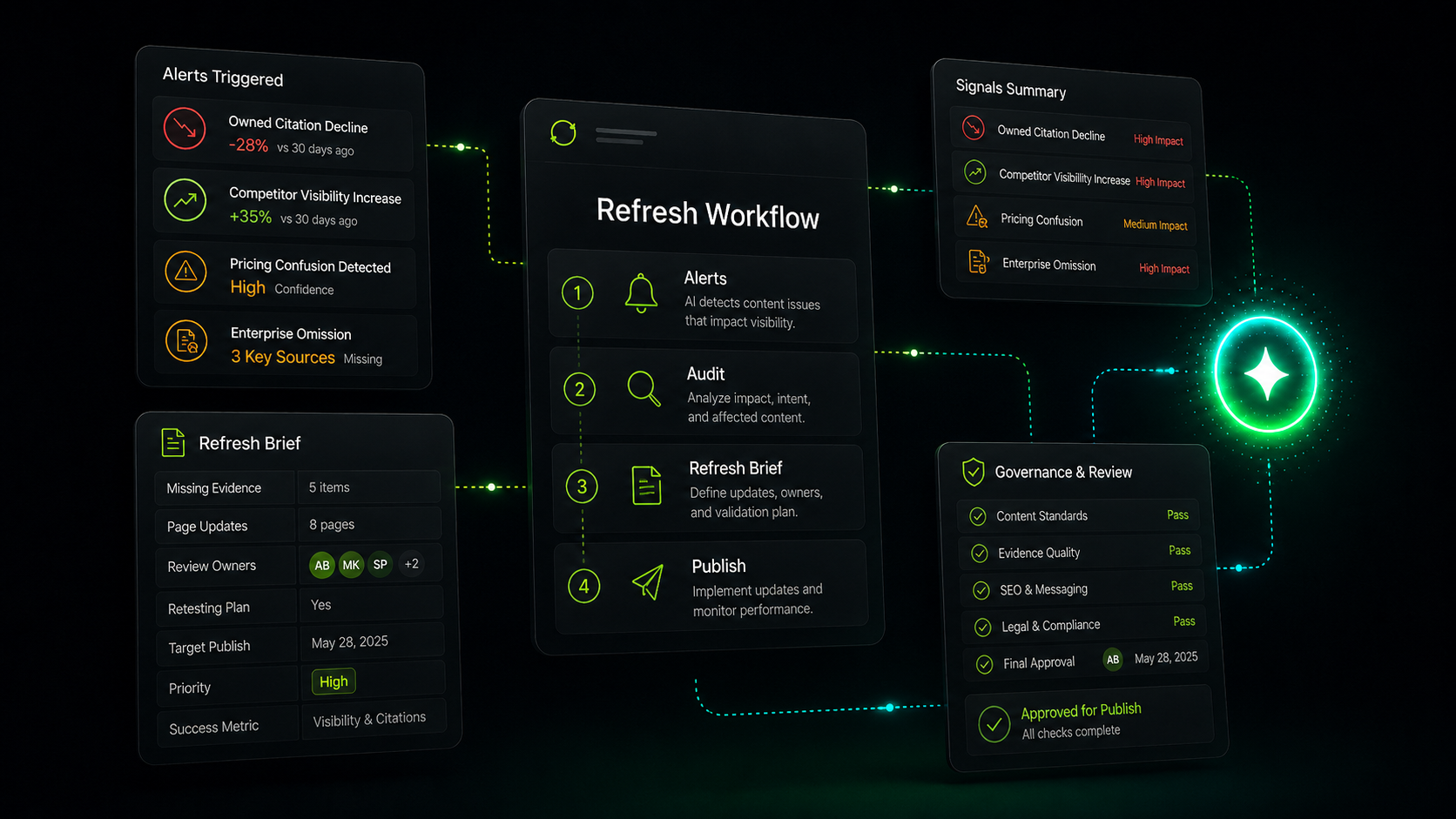
The workflow should look like this:
- Run prompt testing across high-value SaaS buying questions.
- Identify prompts where the brand is absent, misframed, or weakly cited.
- Map each gap to the pages that should support the answer.
- Ask an AI agent to audit those pages against the prompt need.
- Generate a refresh brief for each page or page cluster.
- Have product marketing, content, search, and subject-matter experts review the brief.
- Update the page.
- Re-test the prompt cluster.
- Track whether mention rate, citation rate, or answer framing improves.
A strong refresh brief should include:
- Target prompt cluster.
- Current AI answer behavior.
- Pages involved.
- Missing claims.
- Missing evidence.
- Missing internal links.
- Missing external corroboration.
- Product accuracy issues.
- Suggested content additions.
- Schema or structured data needs.
- Expert review owner.
- Priority score.
This is where agents can be especially useful. They can review a large number of pages, compare them against a defined prompt cluster, identify missing sections, and draft structured recommendations.
But humans still need to approve the work.
That matters because AI-generated content is now common, but not always fully operationalized. In a 2025 SAS report on marketers and AI, 85% of marketers reported using generative AI, but only 15% had fully integrated it into daily workflows.
For SaaS teams, the opportunity is not just using AI more. It is creating a governed process where agents help turn Generative Engine Optimization (GEO) findings into accurate, approved website updates.
5. Optimize the SaaS website as a connected evidence system
Agentic document optimization should not treat each page as an isolated asset.
For SaaS companies, AI visibility depends on how the entire website supports the brand’s meaning, use cases, proof, and positioning.
That means marketing teams need to audit relationships across:
- Homepage.
- Product pages.
- Use-case pages.
- Integration pages.
- Comparison pages.
- Pricing pages.
- API documentation.
- Blog posts.
- Case studies.
- Security pages.
- Help center articles.
- Changelog or release notes.
- Glossary pages.
- Templates and tools.
- Webinar pages.
- Partner pages.
The agentic question is:
Does the full site give AI systems enough consistent evidence to understand, validate, and recommend the product for the right use cases?
This is especially important because AI search can synthesize answers from many sources. Google’s AI feature guidance explains that AI experiences use web content and links as part of generated responses, while still relying on Google Search systems.
The practical implication is that SaaS websites need stronger content alignment across the full buyer journey.
- A product page may explain what the software does.
- A comparison page may explain why it is different.
- A pricing page may explain cost fit.
- A case study may prove business impact.
- A documentation page may prove implementation feasibility.
- A security page may reduce enterprise risk.
- A blog post may explain the category problem.
Agentic document optimization helps teams identify whether those pages reinforce each other or contradict each other.
6. Use agents for content QA, not just content generation
The shallow version of agentic document optimization is “use AI to rewrite pages.”
The better version is “use AI agents as content QA infrastructure.”
That means agents should help SaaS marketing teams check:
- Is this page still accurate?
- Does this page reflect current positioning?
- Does it support the prompt cluster it should support?
- Does it contradict related pages?
- Does it include enough evidence?
- Does it cite customer proof or examples?
- Does it explain pricing, plans, integrations, and limits?
- Does it have internal links to related product pages?
- Does it answer the comparison questions buyers ask?
- Does it contain unsupported or risky claims?
- Does it help an AI system understand the brand clearly?
This matters because marketing teams are under pressure to use AI, but low-quality AI content can create risk. Ahrefs’ 2025 report on AI in content marketing found that marketing and search teams are actively experimenting with generative AI, but the report also frames the central issue as how AI content is created, reviewed, and used inside real editorial workflows.
For SaaS companies, agentic optimization should make content more accurate, specific, and useful. It should not create a larger library of generic pages.
7. Build a faster refresh and governance loop
AI search creates a faster content maintenance cycle.
In traditional search, a SaaS content refresh might happen quarterly or annually. In AI search, answer behavior can change more quickly because different systems may retrieve different sources, cite different pages, or reframe competitors in new ways.
That means SaaS marketing teams need a refresh loop that can respond to:
- Product launches.
- Pricing changes.
- New integrations.
- Feature deprecations.
- New competitor claims.
- Market category changes.
- AI answer misframings.
- Review-site changes.
- Third-party citation shifts.
- New enterprise requirements.
- New prompt clusters that are driving buyer research.
But speed cannot come at the expense of governance.
A good agentic document optimization process should define:
- Which agents can audit content.
- Which agents can draft recommendations.
- Which humans approve changes.
- Which claims require product review.
- Which claims require legal review.
- Which content types can be updated quickly.
- Which pages need stricter approval.
- How changes are logged.
- How old claims are removed.
- How prompt performance is re-tested.
This is especially important for SaaS companies because pricing, security, compliance, customer proof, and competitor claims can create trust or legal risk if they are updated carelessly.
The best model is not agent-only publishing. It is agent-assisted, human-governed optimization.
The Bigger Point
Agentic document optimization is not just a content production tactic.
It is a new operating system for SaaS content maintenance.
As AI systems become part of the buyer journey, SaaS marketing teams need a way to understand what AI engines are surfacing, what they are missing, and what they are getting wrong. Then they need a way to turn those insights into fast, accurate, governed updates across the website.
That is the real value of agentic document optimization.
It helps teams move from:
- Static content libraries to living evidence systems.
- Keyword-first updates to prompt-informed updates.
- One-off refreshes to continuous optimization loops.
- Generic AI writing to agent-assisted content QA.
- Manual audits to scalable document intelligence.
- Slow website maintenance to faster Generative Engine Optimization (GEO) response cycles.
The companies that win will not simply publish more content.
They will build content systems that can detect AI visibility gaps, convert those gaps into page-level actions, and update the SaaS website faster than competitors can adapt.
How to Build an Agentic Document Optimization System
Agentic document optimization becomes much more useful when it is treated as a system, not a writing workflow.
The goal is not simply to have AI rewrite pages. The goal is to build an operating layer that connects AI visibility data, competitor movement, owned website content, product marketing priorities, and governed publishing workflows.
For SaaS marketing teams, that system should answer five questions continuously:
- What are AI engines saying about us?
- What are AI engines saying about our competitors?
- Which sources are being cited or ignored?
- Which owned pages support or weaken those answers?
- Which product, positioning, pricing, or proof gaps need to be fixed first?
That is where tools like Profound, AI visibility platforms, website crawlers, internal content inventories, and APIs become useful. The strongest teams will not rely on a one-time Generative Engine Optimization (GEO) audit. They will build repeatable systems that detect visibility gaps and turn them into prioritized website updates.
1. Build a prompt monitoring layer
The first layer is prompt monitoring.
SaaS teams should define the prompts that matter most across the buyer journey, then track how AI engines answer them over time.
Those prompt clusters might include:
- Category discovery prompts, such as “best software for X.”
- Competitor comparison prompts, such as “Vendor A vs. Vendor B.”
- Use-case prompts, such as “software for automating X workflow.”
- Integration prompts, such as “tools that integrate with Salesforce and Snowflake.”
- Pricing prompts, such as “how much does X software cost?”
- Implementation prompts, such as “how hard is it to implement X?”
- Security prompts, such as “enterprise-ready tools with SOC 2 and SSO.”
- Industry prompts, such as “best software for healthcare teams” or “best software for fintech companies.”
The goal is to understand where the brand is mentioned, cited, omitted, misunderstood, or framed poorly.
A strong prompt monitoring layer should track:
- Brand mention rate.
- Citation rate.
- Cited URLs.
- Competitor co-occurrence.
- Source types cited.
- Answer framing.
- Recommendation language.
- Whether the answer reflects current positioning.
- Whether the answer includes outdated or inaccurate claims.
This is the top of the system. Without prompt monitoring, the team is guessing where to focus.
2. Monitor competitors and source patterns
The next layer is competitor monitoring.
Agentic document optimization should not only ask, “Are we visible?” It should also ask, “Who is becoming more visible than us, and why?”
That means monitoring:
- Which competitors appear most often for priority prompts.
- Which competitors are cited but your brand is not.
- Which competitor pages are being cited.
- Which third-party sources mention competitors.
- Which claims competitors are making on product, pricing, comparison, and use-case pages.
- Which new pages competitors are publishing.
- Which competitors are gaining visibility in specific prompt clusters.
This matters because AI visibility is often relative. A SaaS company can have strong content and still lose visibility if competitors have better source coverage, clearer positioning, more specific product pages, stronger comparison content, or better third-party corroboration.
A practical workflow might look like this:
- Track competitor mentions in Profound or a similar AI visibility platform.
- Export prompt, citation, and source data through available APIs.
- Monitor competitor websites for new or changed pages.
- Identify when competitor content aligns with prompts where they are gaining visibility.
- Compare competitor claims against your own product marketing priorities.
- Trigger alerts when competitor visibility rises in a commercially important prompt cluster.
This turns competitor monitoring into an input for content refreshes, not just a reporting exercise.
3. Crawl your own website and build a content intelligence layer
The third layer is owned-site crawling.
If AI systems are misrepresenting your product, the problem may not be the AI engine. The problem may be that your own website does not clearly explain the thing you want AI systems to understand.
SaaS teams should regularly crawl and classify their own website across key content types:
- Homepage.
- Product pages.
- Use-case pages.
- Industry pages.
- Comparison pages.
- Pricing pages.
- Integration pages.
- API documentation.
- Help center content.
- Case studies.
- Blog posts.
- Changelog pages.
- Security and compliance pages.
- Template or tool pages.
Each page should be mapped to the prompts, claims, use cases, and buyer questions it is supposed to support.
The content intelligence layer should track:
- Which product claims appear on each page.
- Which use cases are covered.
- Which personas are addressed.
- Which industries are mentioned.
- Which integrations are explained.
- Which competitors are referenced.
- Which pricing or packaging details are included.
- Which proof points are used.
- Which internal links support the page.
- When the page was last updated.
- Whether the page contradicts other pages.
This gives the team an internal source of truth. When an AI visibility gap appears, the team can quickly identify which pages should be updated.
4. Connect AI visibility gaps to product marketing priorities
This is the most important layer.
Not every AI visibility gap deserves action. SaaS teams need to compare external visibility signals against internal business priorities.
For example, an alert may show that a competitor is being cited more often for “enterprise workflow automation software.” That only matters if enterprise workflow automation is a market the company actually wants to win.
The team should overlay AI visibility data with product marketing priorities such as:
- New feature launches.
- ICP changes.
- Vertical expansion.
- Enterprise positioning.
- Pricing or packaging changes.
- New integrations.
- Competitive displacement campaigns.
- Sales objections.
- Analyst or review-site positioning.
- Product-led growth priorities.
- Expansion and retention goals.
This keeps the workflow commercially focused.
The best question is not, “Where are we missing from AI answers?”
The better question is:
Where are we missing from AI answers that matter to our current growth strategy?
5. Create alerting mechanisms for priority changes
Once the monitoring and crawling layers are in place, SaaS teams can build alerting workflows.
These alerts should not be generic. They should be tied to prompt clusters, competitor movement, owned-site changes, and product marketing priorities.
Useful alerts might include:
- Owned citation rate drops for a priority prompt cluster.
- A competitor starts appearing more often in “best software” answers.
- A competitor launches a new comparison page targeting your category.
- AI engines start citing a third-party source that does not mention your brand.
- AI answers describe your product using outdated positioning.
- Pricing prompts return vague, incorrect, or competitor-favorable answers.
- Enterprise prompts omit your security, compliance, or governance features.
- Integration prompts cite competitors even though you support the same integration.
- A product launch is not reflected in AI answers after a set number of days.
- A page that should support a prompt cluster has not been updated recently.
This is where agentic document optimization becomes operational.
The system should not only produce reports. It should create work.
6. Turn alerts into refresh briefs
Each alert should become a structured refresh brief.
The brief should explain what changed, why it matters, which pages are involved, and what needs to be updated.
A useful brief includes:
- Prompt cluster.
- Current AI answer behavior.
- Competitors mentioned.
- Sources cited.
- Owned pages that should support the answer.
- Missing claims.
- Missing product details.
- Missing proof points.
- Missing internal links.
- Pricing or packaging gaps.
- Security or enterprise-readiness gaps.
- Recommended page updates.
- Required reviewers.
- Priority level.
- Retesting plan.
Agents can help draft these briefs by comparing AI visibility data against the crawled website inventory. But humans should still validate the recommendations before anything is published.
This is especially important for SaaS because product claims, pricing, security, compliance, and competitive comparisons need review.
7. Build a governed publishing and retesting loop
The final layer is governance.
Agentic document optimization should make SaaS teams faster, but not reckless.
A strong workflow defines:
- Which updates can be made by content or search teams.
- Which updates need product marketing review.
- Which updates need product management review.
- Which updates need legal or compliance review.
- Which updates need sales or solutions engineering input.
- How changes are logged.
- How old messaging is removed.
- How internal links are updated.
- How prompt clusters are re-tested after publishing.
- How results are measured over time.
The loop should look like this:
- Monitor AI answers.
- Detect visibility or framing gaps.
- Crawl owned and competitor content.
- Compare findings against product marketing priorities.
- Generate a refresh brief.
- Review and publish updates.
- Re-test the prompt cluster.
- Measure whether mention rate, citation rate, source inclusion, or answer framing improved.
That is the tactical value of agentic document optimization.
It turns Generative Engine Optimization (GEO) from an occasional audit into an always-on content response system.

