
Generative Engine Optimization is getting dismissed too easily.
Some skepticism is fair. Every major shift in search creates opportunists, recycled playbooks, and vendors trying to rename old tactics as something new. But dismissing Generative Engine Optimization as a gimmick is a different mistake.
The mistake is assuming that because AI search is still changing, it cannot be influenced. Or because attribution is imperfect, it cannot be measured. Or because brand reputation already matters, no new operating model is required.
That is the wrong read.
Generative Engine Optimization is not a gimmick because AI systems are already changing how people discover, compare, and choose brands. More importantly, these systems do not evaluate the web the same way a traditional search engine results page does. They retrieve, summarize, compare, reason, cite, and recommend.
That changes the work.
Generative Engine Optimization is not about “tricking” a large language model. It is about making a brand easier for AI systems to identify, understand, validate, compare, and confidently include in generated answers.
That is not a gimmick. That is the next layer of digital visibility.
Key Takeaways
- Can brands really influence how AI systems describe and recommend them? Yes, but not by “tricking” large language models. Influence comes from improving the evidence layer around the brand: clearer entities, stronger category associations, structured content, third-party corroboration, specific claims, and digital assets that AI systems can retrieve and use.
- Why does Generative Engine Optimization matter now? Because more buyers are using AI systems to compare products, evaluate companies, and narrow decision sets before they ever visit a website. If your brand is excluded from those answers, you are not just losing a ranking. You may be missing from the buyer’s shortlist.
- Is brand strength enough to win in AI search? No. A strong brand helps, but AI systems still need accessible, consistent, and corroborated information. A company can be well known to humans and still be poorly understood by machines if its website, third-party mentions, reviews, comparisons, and proof points are fragmented.
- What should serious Generative Engine Optimization actually look like? It should look less like rebranded SEO and more like an AI search intelligence system. Brands need recurring visibility monitoring, citation analysis, entity auditing, interpretation diagnostics, and agentic recommendations that identify which language, sources, pages, and digital assets need to change.
1. AI Search Behavior Is No Longer Theoretical
The first reason Generative Engine Optimization is not a gimmick is simple: the behavior shift is already happening.
For years, search marketers could safely assume that commercial discovery happened through a familiar pattern. A user searched Google, scanned the results page, clicked a few links, compared options, and eventually converted. That behavior still exists, but it is no longer the only pattern that matters.
A growing share of users now asks AI systems for the answer directly.
They ask which software vendor is best for a specific use case. They ask which ecommerce product is worth buying. They ask for comparisons, shortlists, pros and cons, pricing context, and recommendations. In many cases, they are not asking for a list of blue links. They are asking the system to reduce uncertainty.
That matters because the brand that wins in an AI answer may not be the brand that would have earned the same click in a traditional search journey.
For ecommerce, the shift is especially visible. Eastside Co’s analysis of Generative Engine Optimization for ecommerce cites data showing that traffic from generative AI sources to ecommerce stores grew by 4,700% year over year, while also noting that nearly 60% of shoppers now use ChatGPT or Gemini to help make purchasing decisions.
Shopify’s roundup of AI marketing statistics points in the same direction, noting that by 2027, 50% of people in advanced economies are expected to use AI personal assistants for daily tasks, including product discovery.
The important point is not that every buyer has moved to AI. They have not. The important point is that AI-assisted discovery is now large enough, commercial enough, and behaviorally different enough to require its own visibility strategy.
When a user asks, “What is the best platform for X?” or “Which agency should I hire for Y?” or “What are the most trusted brands for Z?”, the answer may include only a handful of names.
If your brand is not included, you are not buried on page two.
You are absent from the decision set.
2. Generative Engine Optimization Is Different Because AI Systems Don't Behave Like Traditional Search Engines
The strongest argument for Generative Engine Optimization is not simply that AI tools are popular.
Popularity alone does not prove that a new optimization discipline is needed.
The stronger argument is mechanical: AI systems don't behave like traditional search engines.
Traditional search has largely been built around ranking documents against queries. A search engine crawls pages, indexes them, scores them, and presents a ranked list. The user then chooses which result to click.
Generative systems compress that experience.

At the model level, decoder-based large language models generate text by predicting the next token conditioned on the prompt and the tokens that came before it. In Speech and Language Processing, Daniel Jurafsky and James H. Martin explain that decoder language models, including systems like GPT, Claude, Llama, and Mistral, take tokens as input and iteratively generate output tokens one at a time. They describe conditional generation as the process of giving a model an input prompt and having it continue generating text token by token, conditioned on that prompt and the tokens already generated.
That distinction matters.
A large language model is not simply pulling one page from an index and handing it back to the user. It is generating an answer.
When a generative AI product is connected to retrieval systems, search indexes, browsers, or external sources, it may gather information before answering. But the final experience is still different from a traditional search results page. The system retrieves, filters, interprets, summarizes, compares, and synthesizes information into a response.
That changes the optimization target.
A brand is no longer optimizing only for whether one page ranks. It is optimizing for whether the brand’s digital footprint can be retrieved, understood, validated, and used as evidence inside a generated answer.
That includes:
- Whether the brand is clearly defined across owned and third-party sources.
- Whether product, service, category, and audience information is structured clearly.
- Whether claims are backed by evidence.
- Whether pages contain extractable facts rather than vague positioning language.
- Whether external sources corroborate the brand’s expertise, reputation, and differentiation.
- Whether important information is accessible to crawlers and retrieval systems.
- Whether the same entity is represented consistently across the web.
This is why Generative Engine Optimization requires systems thinking.
Most websites were designed for humans first, search engines second, and AI systems accidentally. They may look polished to a buyer but remain hard for an AI-driven retrieval and generation system to interpret. The pages may contain too much brand language and too little factual density. Product pages may be visually rich but semantically thin. Thought leadership may be persuasive but not extractable. Case studies may be impressive but not structured around reusable evidence.
That is the gap Generative Engine Optimization addresses.
It asks a different set of questions:
- Can an AI system understand what this brand does?
- Can it identify the categories the brand belongs to?
- Can it distinguish the brand from competitors?
- Can it find proof for the claims being made?
- Can it retrieve the right source for the right prompt?
- Can it cite the brand accurately?
- Can it recommend the brand confidently for the right use case?
Those are not traditional SEO questions with a new name.
They are retrieval, interpretation, and evidence questions.
3. Yes, AI Systems Can Actually Be Influenced
One of the most common objections to Generative Engine Optimization is that large language models are black boxes, so optimization is impossible.
That argument sounds sophisticated, but it collapses quickly.
Traditional search engines have always been partially opaque. Marketers never had full access to Google’s ranking systems, either. That did not make SEO fake. It meant serious practitioners had to understand systems, observe outputs, test changes, measure patterns, and build durable advantages around known principles.
The same is true here.
You don't need perfect visibility into an AI model to influence whether your brand is retrievable, understandable, and citation-worthy. You need to understand the inputs these systems are likely to use and improve the quality, consistency, and evidentiary strength of those inputs.
This is especially important because many AI search experiences are not just a model generating text from memory. They often combine language models with retrieval systems, search indexes, semantic matching, structured data, external tools, or browsing layers before producing an answer.
That means brands can influence the retrieval and interpretation environment around the model.
A useful example comes from the research paper “Improving Table Understanding with LLMs and Entity-Oriented Search” by Thi-Nhung Nguyen, Hoang Ngo, Dinh Phung, Thuy-Trang Vu, and Dat Quoc Nguyen.
The authors show that large language model performance on table understanding tasks can be improved by using entity-oriented search, which combines full-text search, semantic search, and graph search. Their approach focuses on entities, attributes, semantic similarity, and implicit relationships rather than relying only on preprocessing or keyword matching.
“Our method effectively leverages the semantic similarity between the question and the data stored in the table, along with the implicit relationships between cells.”
That is the important lesson for Generative Engine Optimization.
The paper is not about marketing websites. It is about table understanding. But the underlying principle carries over: AI systems perform better when information is organized around entities, relationships, context, and retrievable evidence.
Brands are not helpless in that environment.
They can make their websites and external footprint easier for AI systems to parse by clarifying entities, relationships, attributes, categories, use cases, comparisons, and proof points. They can create content that is not only persuasive to humans, but easier for retrieval systems to identify, rank, connect, and use as evidence.
AI systems are influenced by the web because they use the web.
They are influenced by structure because they need to parse information.
They are influenced by semantic clarity because retrieval systems need to match meaning, not just exact keywords.
They are influenced by entity consistency because ambiguous entities are harder to retrieve and recommend.
They are influenced by relationships because AI systems need to understand how products, services, audiences, categories, features, and proof points connect.
They are influenced by third-party sources because generated recommendations often require corroboration.
They are influenced by specificity because vague claims are harder to use in generated answers.
They are influenced by freshness because stale information is risky to cite.
They are influenced by reputation because recommendations require confidence.
That does not mean brands can control every answer. They cannot.
But “cannot control” is not the same as “cannot influence.”
Generative Engine Optimization is the work of improving the probability that a brand is retrieved, understood, selected, cited, and framed accurately when an AI system answers commercially relevant questions.
That is a measurable and strategically useful goal.
4. “Just Be the Best Brand” Is Not a Complete Strategy
Another common critique is that Generative Engine Optimization is unnecessary because AI systems will naturally recommend the best brands.
There is some truth in that.
Strong brands have an advantage. If a company has overwhelming awareness, strong reviews, strong media coverage, clear category association, and consistent external validation, it will often perform better in AI-generated answers.
But that does not make Generative Engine Optimization irrelevant.
It actually proves why Generative Engine Optimization matters.
AI systems are not judging “best” in some pure, universal sense. They are working from available evidence. They infer quality, relevance, authority, and fit from the information they can access and interpret.
That means the “best” brand can still be underrepresented if its evidence layer is weak.
A company may have excellent customer outcomes but thin case studies. It may have strong expertise but generic service pages. It may have great product-market fit but inconsistent category language. It may have strong reviews but poor structured data. It may be known in one ecosystem but invisible in the sources AI systems rely on for comparison.
In traditional brand marketing, reputation often lived in the market.
In AI search, reputation also has to be machine-readable.
That is the difference.
Generative Engine Optimization does not replace brand building. It operationalizes brand building for AI-mediated discovery. It makes reputation easier to retrieve, validate, and reuse.
The brands that understand this will treat Generative Engine Optimization less like a content tactic and more like a reputation infrastructure layer.
5. The Real Work Is Building AI Search Interpretation Systems
One of the biggest problems with the current Generative Engine Optimization market is that many brands are being sold SEO in another package.
The language has changed. The dashboards have changed. The pitch now includes ChatGPT, Perplexity, Gemini, Claude, and AI Overviews. But underneath, too many programs still look like traditional SEO: keyword research, content briefs, ranking reports, and a few prompt screenshots.
That is not enough.
Generative Engine Optimization is not simply SEO with different reporting. It requires a more technical operating system for understanding how AI systems reason about a brand.
The serious version of Generative Engine Optimization asks:
- How are large language models interpreting our brand?
- Which entities do they associate with us?
- Which competitors are being compared against us?
- Which sources are shaping the answer?
- Which claims are being repeated?
- Which claims are being ignored?
- Where is the model uncertain?
- Where is the model misrepresenting us?
- Which pages, sources, or digital assets need to change so the system can understand us more accurately?
That cannot be solved with a monthly content calendar alone.
Brands need systems that monitor AI interpretation on a daily or weekly basis. Not just third-party visibility platforms, but custom internal tools that let marketing, search, content, and product teams see how large language models are reasoning across commercially important prompts.
Third-party platforms like Profound, Semrush, Ahrefs, and other AI visibility tools can be useful. They can help benchmark visibility, track citations, compare competitors, and surface patterns at scale.
But they should not be the entire system.
The deeper opportunity is building custom search and marketing intelligence systems around the brand’s own semantic space. These systems can be created with tools like Claude Code, connected to brand content, competitor pages, search results, third-party mentions, structured data, analytics, and prompt libraries, then hosted as internal insight tools for marketing and search teams.
The purpose is not simply to ask, “Do we show up?”
The purpose is to understand why the system interpreted the market the way it did.
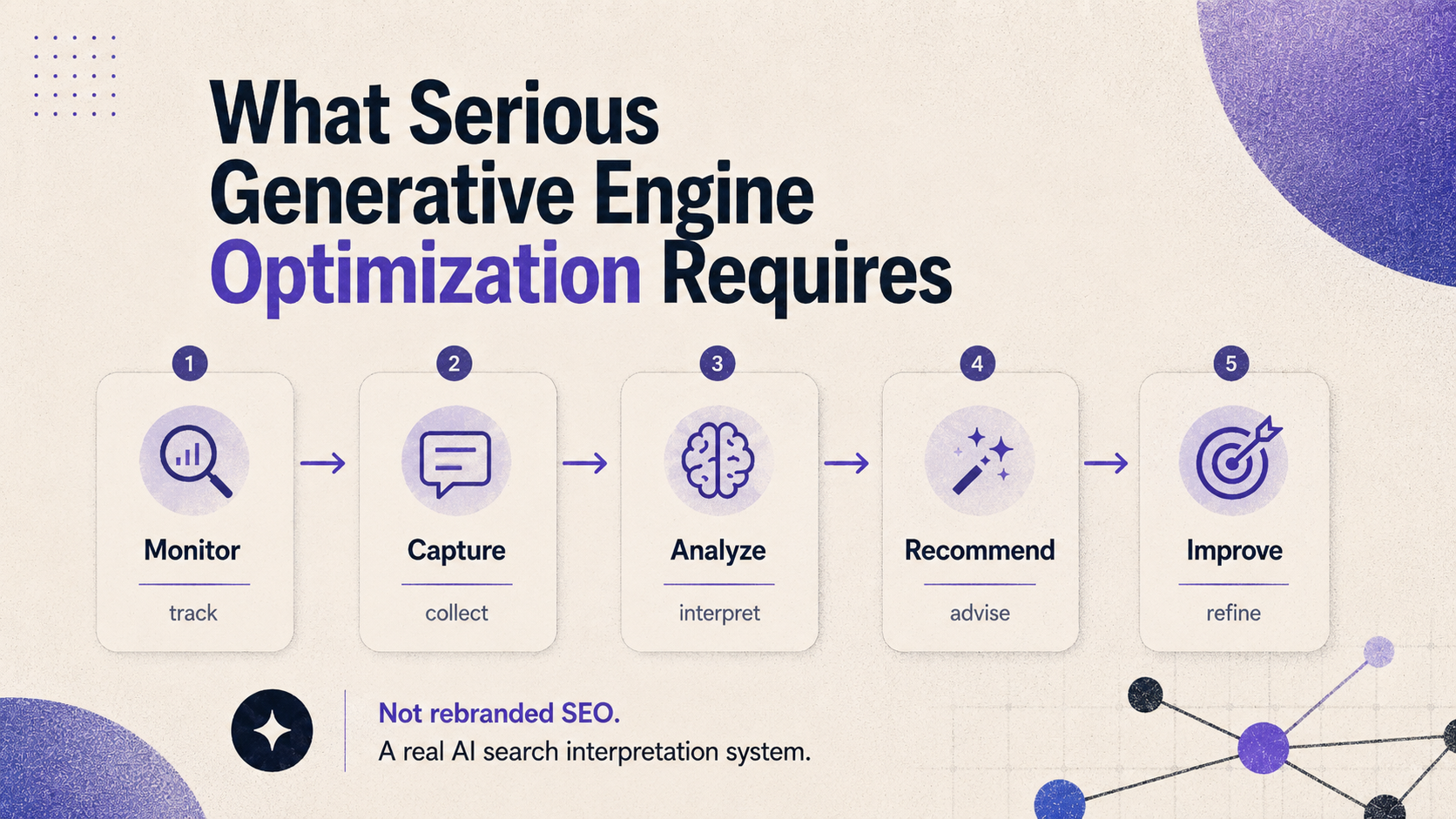
A serious Generative Engine Optimization system should be able to:
- Monitor target prompts across engines on a recurring basis.
- Capture how the brand is described, cited, compared, and excluded.
- Identify which external sources are influencing the answer.
- Detect language gaps between how the brand describes itself and how AI systems summarize the category.
- Compare brand, competitor, and category entity associations.
- Identify missing digital assets, such as comparison pages, use-case pages, documentation, case studies, author profiles, partner pages, or third-party corroboration.
- Recommend language changes where the brand is vague, inconsistent, or hard to classify.
- Recommend asset changes where the model lacks enough evidence to cite or recommend the brand.
- Track whether changes actually improve retrieval, interpretation, citation, and recommendation over time.
This is where Generative Engine Optimization becomes operationally different from SEO.
Traditional SEO often asks, “What page should rank for this query?”
Generative Engine Optimization asks, “What evidence does an AI system need in order to understand, trust, and recommend this brand for this use case?”
That requires a different kind of workflow.
A brand may need agents that review AI answers, identify interpretation gaps, inspect the cited sources, compare competitor language, audit owned pages, and recommend precise updates to content, schema, internal links, digital PR targets, product documentation, or sales enablement assets.
In other words, the future of Generative Engine Optimization is not just measurement.
It is measurement plus diagnosis plus agentic recommendation.
That is why the work is more technical than many people assume. A brand cannot rely only on generic reports. It needs an internal system of record for how AI systems interpret the brand, where that interpretation is wrong or incomplete, and what digital assets need to change in response.
This does not mean every company needs to build a massive software platform.
But it does mean serious brands will need some version of an AI search intelligence layer: a repeatable system that monitors prompts, captures model reasoning, maps citations, audits entity understanding, and turns those insights into action.
That is the real work.
Not prompt chasing.
Not rebranded SEO.
Not another dashboard that tells you whether your brand appeared once in ChatGPT.
Generative Engine Optimization becomes valuable when it helps a brand build the technical feedback loop required to understand how AI systems are interpreting the market — and then systematically improve the language, evidence, and assets those systems rely on.
6. Generative Engine Optimization Creates a New Measurement Layer
Another reason Generative Engine Optimization is dismissed too quickly is that many brands are still trying to measure it with traditional SEO dashboards.
That creates confusion.
If the only metrics are rankings, organic sessions, and last-click conversions, Generative Engine Optimization will look fuzzy. But that does not mean it is immeasurable. It means the measurement model has to change.
AI visibility requires a different set of metrics.
For example:
- How often is the brand included in AI answers for target prompts?
- Which competitors are cited more frequently?
- Which sources are AI systems using to justify recommendations?
- How accurately is the brand described?
- Which use cases does the brand own?
- Which use cases does the brand fail to appear for?
- Is the brand recommended, merely mentioned, or excluded?
- Are AI systems citing owned content, third-party sources, reviews, or competitors?
- Is the brand framed as premium, affordable, technical, beginner-friendly, enterprise-ready, niche, risky, or trusted?
- How does visibility change by engine, prompt phrasing, geography, and buyer stage?
This is closer to an AI reputation score than a traditional rank-tracking report.
That does not make it less valuable. It may actually make it more valuable, because it shows how the market is being summarized by the systems buyers increasingly use to make decisions.
Traditional SEO told brands where they ranked.
Generative Engine Optimization tells brands how they are being understood.
That distinction matters.
7. The Current Wave of Pessimism Is Often Driven by the Wrong People
The current wave of Generative Engine Optimization pessimism is not entirely driven by facts.
Much of it is driven by the SEO community’s discomfort with a changing interface.
That is understandable.
SEO has spent decades optimizing for search results pages. AI systems compress, abstract, and sometimes bypass those pages. They introduce new visibility patterns, new measurement problems, and new attribution gaps. For practitioners who built their careers around rankings and traffic, Generative Engine Optimization can feel threatening, premature, or hard to package.
But skepticism from an incumbent discipline does not invalidate the new behavior.
The same thing happened with mobile search, featured snippets, YouTube search, TikTok search, Amazon search, and zero-click search. Each shift created a period where people argued about whether the new surface “counted.” Eventually, the market answered.
The market is answering again.
Users are asking AI systems for answers. AI systems are recommending brands. Commercial journeys are being influenced before a user lands on a website. The only real question is whether brands want to understand and shape that layer or wait until competitors define the category first.
The “hedge bet” mindset is especially risky.
Brands that treat AI search as a small experiment may underinvest in the foundational work required to build durable visibility. They may run a few prompt tests, see inconsistent results, and conclude the channel is not ready.
But the real opportunity is not short-term prompt volatility.
It is long-term semantic positioning.
In many categories, the AI answer space is still being formed. The associations between brands, use cases, categories, and proof points are not fully settled. That creates a first-mover opportunity.
The brands that build stronger evidence now may become the default references later.
The brands that wait may inherit a future debt: missing structured data, weak entity signals, outdated comparison content, thin third-party corroboration, and years of inconsistent brand representation that need to be cleaned up after competitors have already occupied the answer set.
8. AI Search Rewards Evidence, Not Just Content Volume
Generative Engine Optimization is also not a gimmick because it pushes brands toward better marketing.
The old, low-quality version of SEO often rewarded content volume: more pages, more keywords, more articles, more internal links. That version of SEO created a lot of generic content that technically targeted a query but did not meaningfully help a buyer.
AI search is harsher on that kind of content.
Generated answers need usable evidence. A system cannot confidently recommend a brand based on vague claims like “industry-leading,” “innovative,” or “trusted by teams everywhere” unless those claims are supported elsewhere.
This is where Generative Engine Optimization becomes strategically useful.
It forces brands to create content that is more specific, more factual, and more useful.
For example:
- Instead of saying “best-in-class platform,” explain which use cases the platform is best for.
- Instead of saying “trusted by leading brands,” name the customer segments and provide proof.
- Instead of saying “easy to use,” explain onboarding time, workflow fit, and adoption data.
- Instead of saying “enterprise-ready,” document integrations, governance, security, permissions, and support.
- Instead of saying “AI-powered,” explain what the AI actually does, where it sits in the workflow, and what outcome it improves.
That is not gaming a model.
That is making the brand clearer to both machines and humans.
The irony is that strong Generative Engine Optimization often produces better traditional SEO, better conversion content, better sales enablement, and better brand positioning. That is because the underlying work is about clarity, evidence, and trust.
9. AI Discovery Is Becoming More Agentic
The next phase of Generative Engine Optimization is not just answer visibility.
It is agentic selection.
As AI assistants become more embedded in daily workflows, they will not only answer questions. They will help users narrow options, compare vendors, summarize reviews, check pricing, evaluate fit, and eventually complete more tasks on the user’s behalf.
That changes the stakes.
In a traditional search journey, a user might review ten results. In an AI-assisted journey, the assistant may narrow the field before the user sees the full market.
That means brands need to ask:
Would an AI assistant understand when to recommend us?
Would it know who we are best for?
Would it understand who we are not best for?
Would it find enough trustworthy evidence to include us in a shortlist?
Would it describe us accurately?
Would it choose a competitor because their positioning is clearer?
This is where Generative Engine Optimization becomes more than visibility.
It becomes eligibility.
A brand has to be eligible for retrieval, eligible for comparison, eligible for citation, and eligible for recommendation. Each layer depends on the quality of the brand’s machine-readable and externally corroborated evidence.
This is why Shopify’s point about AI personal assistants and product discovery matters. If AI assistants become a normal layer between consumers and brands, then the brands with cleaner product data, stronger structured content, clearer reputation signals, and better third-party validation will have an advantage.
Not because they “hacked” the assistant.
Because they made the assistant’s job easier.
10. The First-Mover Opportunity Is Real
The strongest reason to take Generative Engine Optimization seriously now is that many categories are still underdeveloped.
Most brands have not yet mapped their AI visibility. They don't know which prompts they appear for. They don't know which competitors dominate AI-generated answers. They don't know which third-party sources are shaping the model’s perception of their category. They don't know whether their own site is helping or confusing AI systems.
That creates opportunity.
In traditional SEO, many categories are mature. The search results are crowded. Authority is entrenched. Competitors have years of backlinks, content, and technical investment.
AI answer spaces are less settled.
The sources used by AI systems vary. The phrasing of prompts matters. The structure of content matters. Third-party corroboration matters. Engine behavior differs. New retrieval systems are still developing.
That volatility is not a reason to ignore Generative Engine Optimization.
It is a reason to start learning earlier.
Brands that invest now can build:
- Stronger entity clarity.
- Better answer-ready content.
- More consistent brand associations.
- A deeper evidence base.
- Better third-party validation.
- Stronger prompt-level measurement.
- More useful competitive intelligence.
- Faster feedback loops as AI systems evolve.
The goal is not to predict the final form of AI search.
The goal is to build the kind of digital presence that performs better across AI-mediated discovery surfaces no matter which interface wins.
That is a practical strategy.
11. The Real Risk Is Semantic Debt
The final reason Generative Engine Optimization is not a gimmick is that ignoring it creates a new kind of debt.
Not technical debt.
Semantic debt.
Semantic debt is the accumulated cost of being poorly understood by machines.
It happens when a brand has unclear positioning, inconsistent category language, thin proof points, weak third-party validation, inaccessible content, outdated pages, missing structured data, and fragmented entity signals across the web.
A human buyer might still piece the story together.
An AI system may not.
And when AI systems cannot confidently understand a brand, they are less likely to cite it, recommend it, or include it in a shortlist.
That is the hidden cost of waiting.
Brands that delay Generative Engine Optimization may eventually discover that competitors have already trained the market’s machine-readable evidence layer around different narratives. Those competitors may own the comparison pages, third-party mentions, citations, category associations, and prompt-level visibility that shape how AI systems summarize the space.
Paying that debt down later will be harder than building the foundation now.

